




ChatGPT ads have evolved from pilot to a genuine advertising channel. In February 2026, OpenAI began testing ads within ChatGPT, and in May it opened a self-serve platform, OpenAI Ads Manager, to every US business. For marketers, this is the clearest signal yet that ChatGPT is becoming a fully-fledged paid channel, not just a place to be organically visible.
This guide explains exactly what ChatGPT ads look like, how the platform works, what they cost, and how you determine whether they belong in your marketing mix for 2026.
What are ChatGPT ads?
ChatGPT ads are paid placements that appear within ChatGPT conversations, OpenAI's version of AI advertising, built specifically for a conversational format rather than search results or social feeds. Instead of bidding on keywords, advertisers bid on relevance to the context and intent of a conversation. ChatGPT is currently the most developed example of this model, with its own dedicated self-serve advertising platform, while other AI tools such as Google's AI Mode and Microsoft Copilot route advertisers back to their existing advertising platforms (Google Ads and Microsoft Advertising, respectively).
How do ChatGPT ads work?
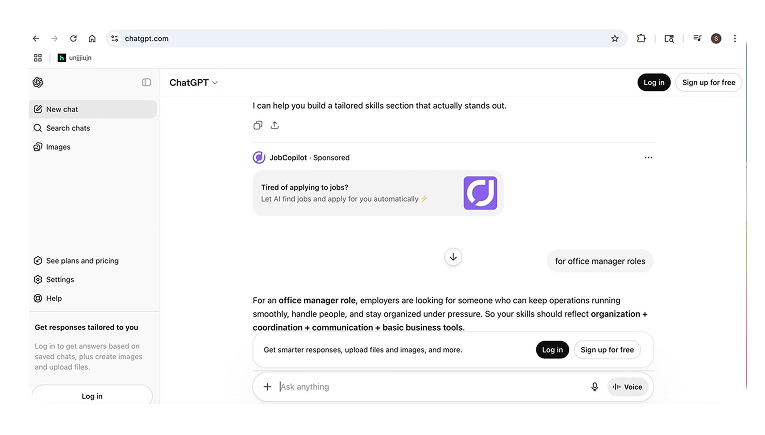
Ads appear as clearly labeled, sponsored placements below a ChatGPT response, never within the AI-generated answer itself. OpenAI has explicitly stated that ads run on a separate system from the chat model and cannot influence, shape, or rank the actual response. Rather than matching keywords, ChatGPT's ad system evaluates the context and intent of the full conversation to determine which ad, if any, is relevant. This means ad creative needs to solve a user's problem or answer their question, not simply promote a product, since users are typically already in a research or decision-making phase when they use ChatGPT.
Who can advertise?
On the user side, ads only appear for people on ChatGPT's Free and Go plans; Plus, Pro, Business, Enterprise, and Edu users see no ads at all.
On the advertiser side, access has expanded quickly.
In February 2026, there was a closed beta, limited to large advertisers and agency holding companies (including Omnicom, WPP, Target, and Adobe). In the early access phase, minimum spend commitments were roughly $200,000 to $250,000. In April 2026, the minimum was lowered to roughly $50,000, with the introduction of a self-serve manager. On May 5, 2026, OpenAI Ads Manager was opened to all eligible US businesses, with no minimum spend requirement.
Note: these figures reflect the eligibility requirements and spend requirements as they stood at the time this article was published. OpenAI Ads Manager is still expanding, and minimums, requirements, and country availability may change. Check ads.openai.com for current terms before planning a campaign.
Any business, from a small ecommerce store to a mid-sized marketing team, can now apply to run campaigns via ads.openai.com, pending approval.
What Do ChatGPT Ads Cost?
According to industry reporting on the platform (these figures come from agencies actively running campaigns, not from OpenAI's own published pricing), ChatGPT ads run on a relevance-weighted, second-price auction with two bidding models. CPC campaigns (cost per click) have recommended starting bids of roughly $3 to $5 per click, while CPM campaigns (cost per thousand impressions) have a standard maximum bid of roughly $60 CPM.
A commonly cited starting daily budget for testing purposes is $50 to $100, similar to how marketers test new channels like Meta or programmatic display before scaling up spend.
Best fit businesses for ChatGPT ads
Based on early advertiser activity, ChatGPT ads tend to perform best for categories where users ask a lot of questions before buying: B2B SaaS and software, professional services, education, and ecommerce products with a higher consideration threshold.
Local service businesses and regulated categories such as healthcare and finance are advised to wait, both because of eligibility restrictions and because OpenAI currently excludes ads entirely from sensitive or regulated topics like personal health, mental health, and politics.
ChatGPT Ads vs Google Ads vs Meta Ads
ChatGPT ads are not a replacement for existing channels, they are a new layer in the funnel. A useful way to think about it: Google Ads captures users who are actively searching with purchase intent. Meta Ads builds awareness and demand at scale. ChatGPT Ads reach people while they're researching, comparing, and asking for advice, a "messy middle" moment that other channels don't fully own.
Marketers running ChatGPT campaigns also report less targeting and reporting capability than they're used to from Google Ads, so expect a steeper learning curve and less detailed optimization data during this early phase.
Privacy and Trust: What Advertisers Can See
OpenAI has built specific safeguards into ChatGPT ads to preserve user trust. Advertisers never see a user's chat history, memories, or personal data. Advertisers only receive aggregated performance data: total views and clicks. Ads are not allowed to appear near sensitive personal topics or political content. Users can turn off ad personalization at any time or clear their ad data.
For marketers, this means campaign optimization will rely more on creative relevance and context-matching than on detailed audience targeting, a fundamentally different skill than traditional PPC.
How do you start advertising on ChatGPT?
Request access via ads.openai.com and wait for approval. Prepare your product data. For shopping and local intent results, ChatGPT pulls data from merchant feeds; outdated feeds mean your ads simply won't be shown. Build your creatives around prompts and problems, not keywords. Write for the questions your customers are actually asking ChatGPT. Start with a small test budget (often $50 to $100 per day) with CPC bidding to gather early performance data. Combine paid placement with organic visibility. Since ChatGPT also shows brands organically in its answers, combining ChatGPT ads with content and SEO efforts optimized for AI search (sometimes called GEO, or Generative Engine Optimization) usually strengthens results.
Do ChatGPT ads belong in your strategy for 2026?
If your customers do extensive research before buying, comparing options, asking detailed questions, weighing tradeoffs, then ChatGPT ads are worth testing early. The ad space is still relatively uncrowded compared to mature platforms like Google and Meta, which historically has led to lower costs and more first-mover data for early adopters of new advertising platforms.
That said, treat ChatGPT ads as one channel within a broader mix, not as a full replacement for Google or Meta. This is a new AI advertising format, and best practices, targeting options, and measurement tools are still evolving on a monthly basis.
Sources:
help.openai.com "Ads in ChatGPT"
openai.com "Testing ads in ChatGPT"
openai.com "Our approach to advertising and expanding access to ChatGPT"


