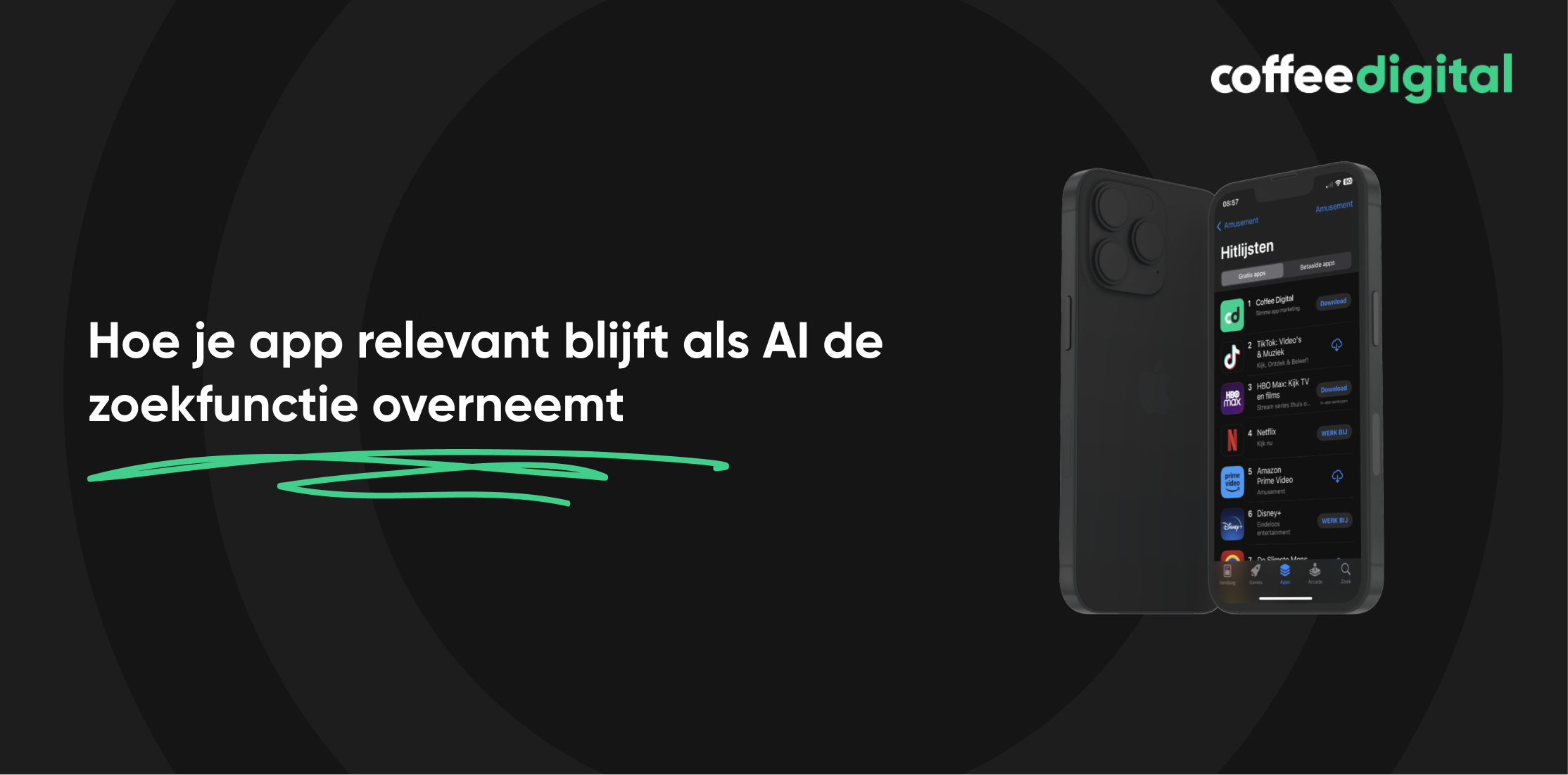
AI is increasingly deciding which apps users see. If you aren't discoverable, understandable, and quotable now, you’ll disappear from view before the user even opens the App Store.
AI assistants: how to keep your app visible in 2026
In 2026, app discovery is shifting rapidly from classic search results and store listings to AI-driven answers, assistants, and recommendations. Users are typing fewer individual keywords and focusing more on complete tasks or problems. As a result, it’s not just your App Store ranking that counts, but whether an AI assistant understands what your app does, who it’s for, and why your solution is the best choice. For brands, this means a new reality: app visibility outside the App Store is becoming just as important as ASO, while content, AI mentions of your app name, and clear use cases contribute directly to your discoverability.
#1. Google AI mode is changing how apps are found
Since October 2025, Google has rolled out AI mode in over 200 countries, according to Google Support. As a result, users are seeing direct answers more often than a list of links. For your app, this means one simple thing: ranking high is no longer enough. According to Nedfinity and Digital Kiss , the number of direct website clicks is dropping, while Bright emphasizes that the remaining clicks are more targeted. What now? Check Search Console to see if you appear as a source and create clear Q&A and comparison pages around your app's use cases. Don't have a website for your app yet? It’s time to build one, as app stores offer limited space for information, whereas a website gives you plenty of room to explain your app properly.
Make it technically easy for yourself, too. Use clear subheadings, short answers, and consistent terminology for your app name, target audience, and the problem you solve on your key web pages. Additionally, add an FAQ and a comparison block. This helps AI understand and index your content more quickly. Do you have multiple target audiences? Create a separate web page for each, rather than one general sales page.
Sources: Coffee Digital, Google Support / Google LLC, Nedfinity, Digital Kiss, Bright
#2. AI-driven app discovery starts with tasks, not categories
App discovery is shifting from the search bar to the AI assistant. According to Adformatie and Ponck users are increasingly asking full questions to ChatGPT, Gemini, or Perplexity instead of typing in individual keywords. This completely changes AI-driven app discovery: the assistant creates a shortlist itself, often before someone even opens the App Store. How do you respond to this? Describe your app in a task-oriented way, not vaguely. So, don't write "productivity app," but rather what someone can accomplish with it. Do this for your store listing and your website. And investigate whether your app fits into ecosystems like Gemini, ChatGPT tools, or Apple Intelligence.
The big question isn't whether AI assistants are on the rise, but whether your app will even end up on their shortlist. If your positioning is still only about categories instead of tasks, the assistant will likely choose a competitor that explains in a single sentence what the user can accomplish with it.
Also, look beyond your own site. Is your app listed in places where people and AI look for solutions, such as niche platforms, review sites, or comparison tools? Make sure the explanation is consistent everywhere. Use the same short promise, the same use cases, and the same app name every time. This prevents confusion and increases the chance that an assistant will recognize your app as the logical choice.
Sources: Coffee Digital, Adformatie, Ponck
#3. App visibility outside the App Store requires quotable content
New rules apply to app visibility outside the App Store. Nowadays, we call this Generative Engine Optimization, GEO: optimizing to be chosen and cited by AI. You only succeed if AI knows your app exists, understands what your app is intended for, and trusts your brand, according to Nedfinity, Ponck and Digital Kiss. So, ask yourself one question: can an AI assistant extract your use case directly from your site? Rewrite key pages in a Q&A format and build up reviews, trade media coverage, and strong brand mentions in the Dutch market.
This is often the blind spot. Many apps have great store copy, but hardly any pages online that an AI can literally quote. If your use cases aren't clearly reflected in reviews, FAQs, and expert content, why would an AI trust and recommend your brand?
Take a practical approach with a mini-audit of your top 5 pages. Does each page state within seconds what the app does, who it's for, and when to use it? If not, make the text more concrete. Also, add case studies, reviews, and how-tos. These are exactly the signals that help establish your brand as a reliable solution.
Sources: Coffee Digital, Digital Kiss, Nedfinity, Ponck

#4. Your future App Store strategy must go beyond ASO
ASO remains important, but your app store future strategy requires more than just keywords. According to Digital Kiss, Ponck and Nedfinity store algorithms are increasingly understanding semantics, while external signals are carrying more weight. This also impacts your Apple Intelligence app ranking and visibility in AI recommenders. Therefore, write your store copy as an answer to real questions: who is the app for, what problem do you solve, and when should someone choose your app? Nedfinity and Adformatie also observe that landing pages outside the store are appearing more frequently in AI overviews. So, allocate time and budget toward content, partners, and conversational search intent for apps
As mentioned earlier, it is now all about explaining clearly, being visible in the right places, and building trust. Therefore, combine strong store copy with separate use-case pages, clear FAQs, reviews, and mentions outside the store. Then, measure where your traffic is coming from and adjust accordingly. Those who set this up correctly now will be chosen, mentioned, and downloaded more often. Waiting is simply more expensive here.
Sources: Coffee Digital, Digital Kiss, Ponck, Nedfinity, Adformatie
Our role in this
At Coffee Digital, we don't translate this into isolated pieces of advice, but into a data-driven approach using the GROW Framework: first get a sharp, clear-eyed view of goals and reality, then optimize and scale. This way of working already delivered a 250 percent increase in organic downloads and 83 percent more iOS conversions for Route.nl. For apps that want to remain relevant in AI search environments, it comes down to the same foundation: clear positioning, strong content, and data-backed choices. Do you want this too? Get in touch with the marketers at Coffee Digital.