

Downloads are easy to count, but they don't pay the bills. An app with 10,000 installs from users who leave after one day is worth less than an app with 1,000 users who stay for a year and pay.
LTV and CAC make that difference clear. With these two figures, you can determine which campaigns contribute to sustainable growth and which ones mainly generate impressive-looking volume numbers.
What are LTV and CAC?
LTV (Lifetime Value) is the total gross profit a user generates as long as they use your app.
LTV = average monthly revenue per user × average customer lifespan in months × gross margin
CAC (Customer Acquisition Cost) is the cost to acquire one new customer. By customer, we mean a user who performs the action that matters to your business, such as a purchase or subscription.
CAC = total marketing spend ÷ number of new customers
CAC is therefore not the same as CPI, or cost per install. If you pay €2 per install and only one in five users becomes a paying customer, your CAC is €10, not €2.
Why you should look at LTV and CAC together
In isolation, these figures don't tell the whole story. A CAC of €20 is fine when your LTV is €100, but unsustainable when a customer only generates €15 on average.
That is why you look at the ratio:
LTV:CAC ratio = LTV ÷ CAC
A common rule of thumb is approximately 3:1. However, the right ratio depends on your margins, growth goals, and available budget. Furthermore, a high ratio is not automatically good news if it takes a long time to earn back your acquisition costs.
For that, you use the payback period:
Payback period = CAC ÷ (monthly revenue per user × gross margin)
A simple calculation example
The following figures are for illustration:
- Monthly revenue per user: €5
- Average customer lifespan: 8 months
- Gross margin: 85%
- Advertising budget: €3,000
- New paying users: 300
The calculation then becomes:
- LTV: 5 × 8 × 0.85 = €34
- CAC: 3,000 ÷ 300 = €10
- LTV:CAC ratio: 3.4:1
- Payback period: approximately 2.4 months
Suppose the CAC rises to €25 during a busy season. The picture then changes significantly:
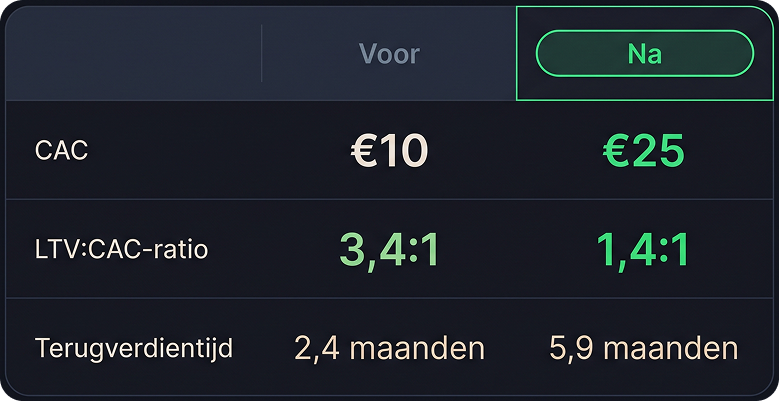
The number of installs may still look good. Yet, the growth has become much less profitable.
How to get more out of LTV and CAC
1. Define your terms and ensure your measurements are accurate
First, determine what counts as a customer within your organization. Is it someone who registers, starts a trial, makes a purchase, or signs up for a subscription? Also, agree on whether you are calculating based on revenue or margin.
Next, ensure your ad spend attribution is linked to relevant in-app events, such as registration, trial starts, and purchases. Without reliable data, you cannot make informed decisions about budgets and channels.
Establish these definitions in advance. This prevents marketing, finance, and management from looking at the same numbers while interpreting them differently.
2. Segment instead of averaging everything
An average LTV can hide significant differences. Therefore, break down your results by:
- channel
- campaign
- keyword
- country
- cohort
Often, a small group of keywords or campaigns accounts for the majority of valuable users. Other sources might deliver cheap installs, but rarely result in paying customers.
This breakdown is exactly what shows you where you can scale up and where budget is leaking away.
3. Focus on customer value, not volume
You don't always have to wait months before you can say something about LTV. Early indicators, such as seven-day retention or the conversion rate from trial to paid subscription, can help estimate future customer value.
Shift your budget toward campaigns and keywords with the best LTV:CAC ratio, even if the CPI is higher there. A more expensive install can ultimately be more cost-effective if that user stays longer and generates more revenue.
Within Apple Search Ads, it is therefore better to optimize for paying users rather than just installs. Use negative keywords to exclude traffic that clicks or downloads but doesn't fit your offering.
4. Lower CAC without compromising on quality
A strong ASO approach generates more organic users, thereby lowering your average acquisition costs across all channels.
The alignment between the ad, the keyword, and the store listing also plays a role. Custom Product Pages that match search intent can increase conversion. With A/B testing on screenshots, videos, and other creative assets, you can discover which presentation convinces the right users.
Higher conversion means you pay less per new customer, without having to target lower-quality traffic.
5. Increase LTV with retention and monetization
A user who stays longer can also generate value for longer. Therefore, look beyond acquisition and investigate where users drop off.
You can do this by, for example:
- making onboarding shorter and clearer
- re-engaging users with relevant messages
- fixing drop-off points in the customer journey
- testing the paywall
- comparing pricing and subscription models
- testing different trial period lengths
Small adjustments can increase revenue per user without requiring extra ad spend. Always measure the effect on both conversion and retention. A change that generates more revenue in the short term could lead to more cancellations in the long term.
6. Monitor payback period and evaluate monthly
A strong LTV:CAC ratio with a fourteen-month payback period can still put pressure on your cash flow. Especially when you are scaling up quickly and paying acquisition costs upfront, while the revenue comes in later.
Therefore, review LTV, CAC, and payback period monthly by cohort. Also, define in advance at what threshold you will scale up, adjust, or stop. This is especially important during busy periods, such as around the holidays, when acquisition costs often rise.
From installs to sustainable growth
LTV and CAC make app marketing less dependent on assumptions. They show you which channels you can scale, where you should cut budget, and what a new user is truly worth.
This shifts the focus from maximizing downloads to attracting the right customers: users who stay, pay, and contribute to sustainable growth.
Want to know what your users are actually worth? Coffee Digital combines ASO, Apple Search Ads, performance marketing, and retention strategies to go beyond just driving installs—we find customers who stick around and pay. Feel free to get in touch with us.