
It's early June, and that traditionally means the tech world is glued to the screen for Apple's Worldwide Developers Conference (WWDC). While consumer media is buzzing about the new Siri AI features and iOS 27, we as app marketers and developers are naturally looking more closely at what's happening behind the scenes. Because under the hood of the App Store, Apple has presented a substantial set of updates that will drastically change the way we market, test, and monetize apps.
Last year we already saw how Apple emphasized AI-driven personalization, but in 2026 they're really opening up the entire marketing toolbox. Do you have an app in the store or are you working on a new launch? These are the most important App Store insights from WWDC 2026 and what this means for your app marketing strategy.
Creative Assets: Finally decoupled from developer builds
Let's start with the biggest game-changer for marketing teams: Creative Assets. Until now, updating visual content in the App Store was often a logistical challenge. Did you want to launch a seasonal campaign (think Christmas or Black Friday) or polish your visuals for a new Apple Ads campaign? Then it almost always had to be tied to releasing a new version.
Starting in the fall of 2026, that changes completely. You can place rich images and videos in the header of your product page and directly in the search results.
The big advantage? No more unnecessary back-and-forth between Development and Marketing.
No more waiting for development sprints to go live with a marketing campaign. Your marketing team gets full control over the visual roadmap. Moreover, you can test these new assets directly via custom product pages (CPPs) to see which visual hooks convert best.
The central Asset Library
To ensure you don't lose track of all those different custom product pages and seasonal visuals, Apple is introducing the Asset Library in App Store Connect.
This will become the central hub where all marketing materials, from screenshots and app previews to the new Creative Assets, are managed in one place. You can effortlessly reuse assets for different CPPs and In-App Events. This eliminates the need for duplicate uploads and ensures a streamlined workflow between designers and marketers.
ASO alert: Organic discovery via Personalized Collections
App Store Optimization (ASO) is shifting more and more from purely 'keyword searching' to 'being discovered through personalization.' Apple is going all-in on this this year with Personalized Collections and App Notes.
This is a brand-new organic overview (starting in the US/UK, but the rollout to the Netherlands will follow soon) in which algorithms recommend apps based on the user's specific interests. Apple's editorial team adds so-called App Notes to this: short editorial explanations of why that specific app is worth checking out.
What does this mean for your ASO strategy?
You will need to focus even more sharply on the signals that feed Apple’s algorithm: high engagement rates, positive reviews, and a flawless app experience. Ensure your product page is clear so that the algorithms (and the Apple editorial team) know exactly which niche your app excels in.
Subscriptions: Retention tools and group subscriptions
For apps that run on a subscription model (and want to maximize that coveted Customer Lifetime Value), WWDC 2026 brings two very welcome features.
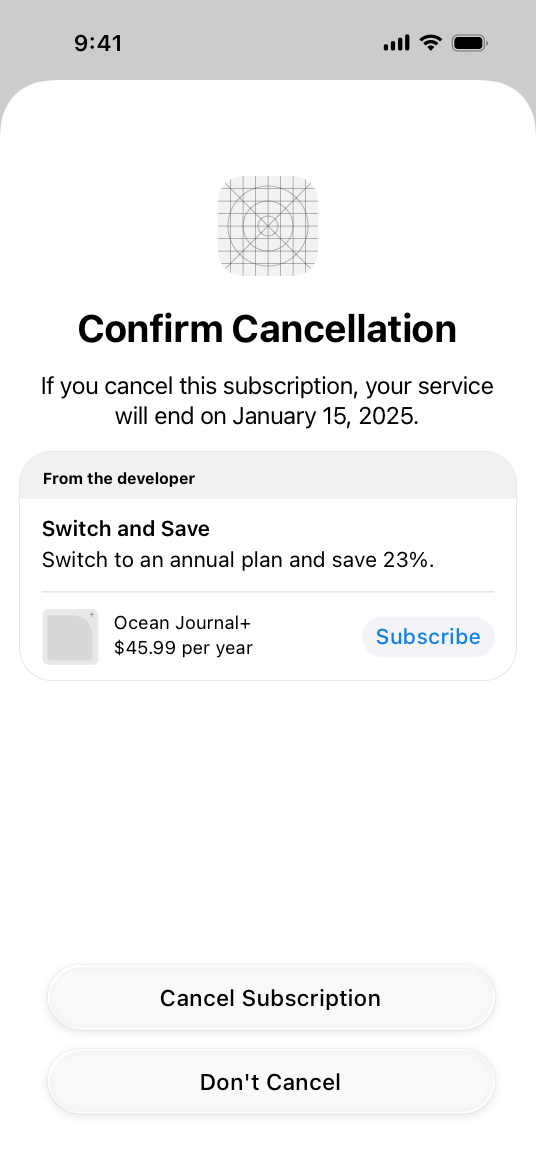
- Retention Messaging for everyone: As an app owner, you get better tools to combat churn . As soon as a user tries to cancel their subscription, you can display targeted retention messages and tailored offers directly through the platform to keep them on board.
- Group purchases and bundles (StoreKit 2): Apple's StoreKit 2 now makes it possible to offer group subscriptions (great for B2B or families), where one person pays and can distribute multiple 'seats'. Additionally, you can now collaborate with other app developers to offer combined bundles and suites .
New privacy and rating rules (Effective July 2026)
Finally, an important action item for the near term. In July, the age rating questionnaire in App Store Connect will be updated. Apps that include social features or User Generated Content (UGC) will be required to explicitly declare this from that point on.
If you fail to do this, or provide incorrect information, you risk your app being placed in the wrong Time Allowancecategory (Screen Time) for iOS. This can directly lead to a significant loss in reach among a crucial target audience: children and teenagers. Go through this with your development team right away to check if your settings are still correct.
Work to be done for marketing teams
The 2026 App Store updates show that Apple is taking App Marketing seriously. The ability to test and update visuals independently of code releases, combined with deeper subscription models and AI-driven recommendations, offers huge opportunities to boost your conversion (CRO) and organic growth.
Are you excited about these new features, but unsure how to set up your custom product pages or ASO strategy for Apple's new direction?
We would love to help you make your app marketing future-proof. Feel free to contact us!
External sources:
- Apple Newsroom (Official Announcement): Apple expands App Store capabilities to help developers grow and reach new users
- WWDC 2026 Event Core Highlights (Siri AI, iOS 27 features & daily limit details): 9to5Mac WWDC 2026 Live Hub & CNET WWDC 2026 Live Recap